
Warum Deutsche bei Temu und Shein kaufen
Die bevh-Weihnachtsumfrage 2025 liefert Zahlen, die unbequem sind. Wer sie ignoriert, versteht seine Kund:innen nicht.
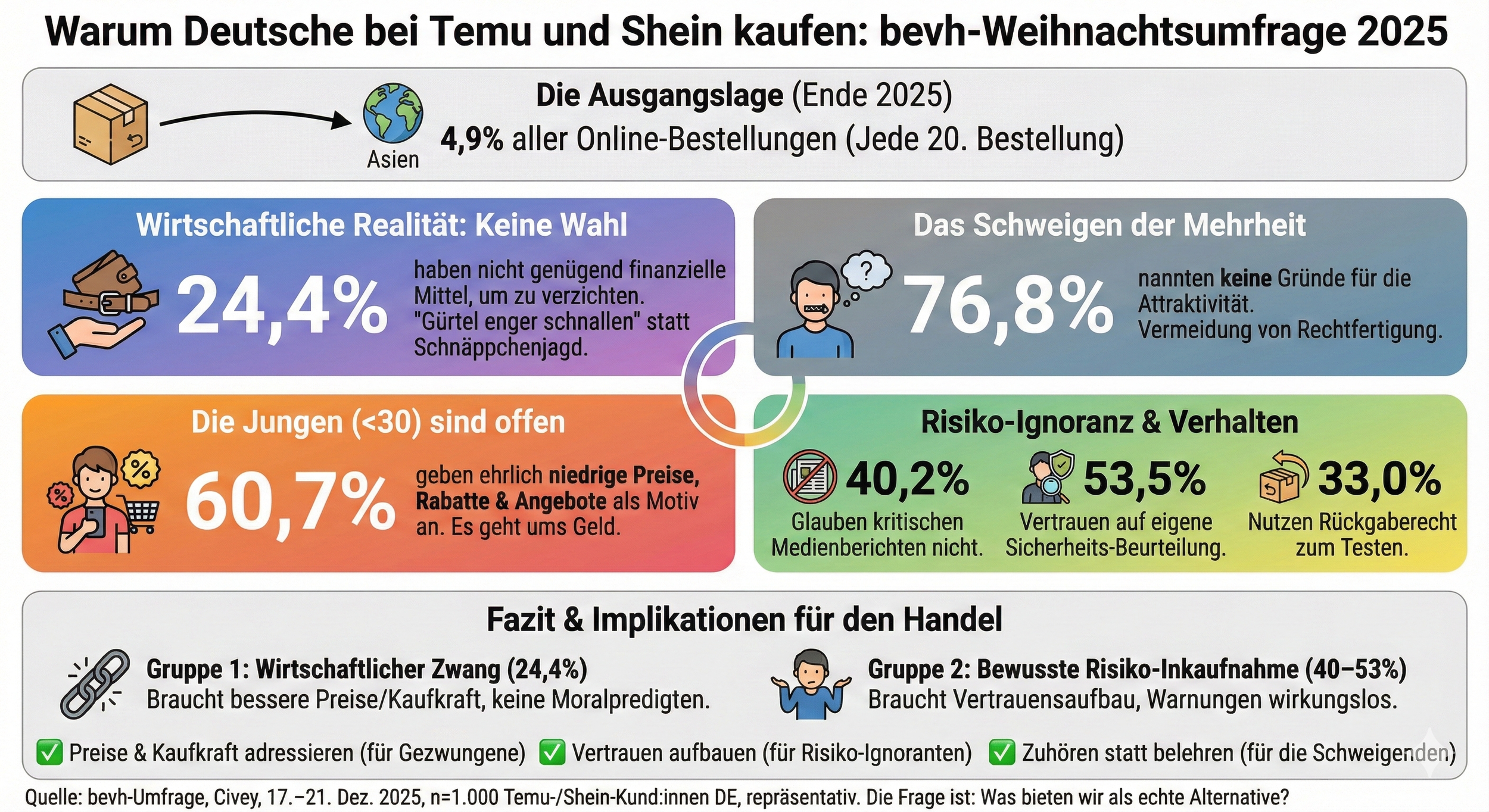
Die Ausgangslage: Jede 20. Bestellung geht nach Asien
4,9 Prozent aller Online-Bestellungen aus Deutschland entfielen zum Jahresende 2025 auf Billigplattformen wie Temu und Shein. Das klingt nach wenig. Ist es aber nicht.
Jede zwanzigste Bestellung. Bei Millionen von Paketen pro Tag.
Der bevh hat daher 1.000 Kund:innen dieser Plattformen gesondert befragt. Repräsentativ. Zwischen dem 17. und 21. Dezember 2025.
Die Ergebnisse zeigen ein Bild, das komplexer ist als die übliche Erzählung vom „Schnäppchenjäger".
Die zentrale Zahl: 24,4 Prozent haben keine Wahl
Fast ein Viertel der Befragten gab an, aktuell nicht über genügend finanzielle Mittel zu verfügen, um auf die Billigplattformen verzichten zu können.
24,4 Prozent.
Das ist keine Lifestyle-Entscheidung. Das ist wirtschaftliche Realität.
Daniela Bleimaier vom bevh fasst es so zusammen: „Der Spaß an der Schnäppchenjagd tritt in den Hintergrund. Immer mehr Menschen sehen aktuell keine andere Wahl, als den Gürtel enger zu schnallen."
Das Schweigen der Mehrheit: 76,8 Prozent nennen keine Gründe
Auf die Frage, was die asiatischen Plattformen so attraktiv macht, wollten vier von fünf Befragten nicht antworten.
76,8 Prozent nannten ihre Gründe nicht - oder wollten sie nicht zugeben.
Das ist bemerkenswert. Offenbar wissen viele Kund:innen, dass ihr Kaufverhalten kritisch gesehen wird. Sie schweigen lieber, als sich zu rechtfertigen.
Die Generationenfrage: 60,7 Prozent der Jungen sind offen
Eine Ausnahme bilden die Unter-30-Jährigen. Sie antworten ehrlich.
60,7 Prozent dieser Altersgruppe geben offen an, bei Temu und Shein wegen niedriger Preise, Rabatten oder besonderer Angebote einzukaufen.
Keine Ausreden. Keine Umwege. Es geht ums Geld.
Die Risiko-Ignoranz: Drei Zahlen, die aufhorchen lassen
Dass Billigwaren von asiatischen Plattformen häufiger Qualitätsmängel, Sicherheitsrisiken und Schadstoffe aufweisen, ist durch umfangreiche Berichterstattung bekannt.
Trotzdem zeigt die Umfrage ein erstaunliches Bild:
Glauben den kritischen Medienberichten nicht: 40,2%
Vertrauen darauf, selbst beurteilen zu können, ob ein Produkt sicher ist:53,5%
Nutzen bewusst das Rückgaberecht, um günstige Produkte zu testen 33,0%
Mehr als die Hälfte der Befragten ist überzeugt, Produktsicherheit selbst einschätzen zu können.
Fast ein Drittel hat das Rückgaberecht als Teststrategie in den Kaufprozess eingebaut.
Und vier von zehn glauben den Warnungen schlicht nicht.
Die Zahlen in Relation: Zwei Gruppen, ein Problem
Die Umfrage zeigt zwei unterschiedliche Motivlagen, die sich überlagern:
Gruppe 1: Wirtschaftlicher Zwang (24,4%)
Diese Kund:innen kaufen bei Temu und Shein, weil sie es sich nicht anders leisten können. Sie wissen um die Risiken. Sie haben keine Alternative.
Für diese Gruppe ist jede Diskussion über bewussten Konsum eine Luxusdebatte.
Gruppe 2: Bewusste Risiko-Inkaufnahme (40–53%)
Diese Kund:innen kennen die Berichte - und ignorieren sie. Sie vertrauen auf ihre eigene Einschätzung oder halten die Warnungen für übertrieben.
Für diese Gruppe sind Appelle von Handel, Politik und Verbraucherschutz wirkungslos.
Was das für den Handel bedeutet
Alien Mulyk, Geschäftsführerin Public Affairs Europa & International beim bevh, zieht ein nüchternes Fazit:
„Wir müssen feststellen, dass viele Verbraucher für die Appelle von Handel, Politik und Verbraucherschutz nicht zugänglich sind. Wenn wir wirklich wollen, dass sicher und nachhaltig eingekauft wird, muss sich die wirtschaftliche Lage verbessern."
Die Zahlen zeigen: Es gibt nicht den einen Hebel.
✅ Wer die wirtschaftlich Gezwungenen erreichen will, muss über Preise und Kaufkraft reden - nicht über Moral.
✅ Wer die Risiko-Ignoranten erreichen will, muss Vertrauen aufbauen - nicht Warnungen wiederholen.
✅ Wer die schweigende Mehrheit verstehen will, muss zuhören - nicht belehren.
Fazit: Wer diese Zahlen ignoriert, redet an der Realität vorbei
Die bevh-Umfrage zeigt keine einfache Wahrheit. Sie zeigt eine Gesellschaft im Spannungsfeld zwischen wirtschaftlichem Druck und selektiver Wahrnehmung.
Ein Viertel kann nicht anders.
Fast die Hälfte will nicht anders.
Und der Rest schweigt.
Wer im E-Commerce erfolgreich sein will, muss diese Ambivalenz verstehen. Nicht moralisieren. Verstehen.
Die Frage ist nicht: Warum kaufen die Menschen bei Temu und Shein?
Die Frage ist: Was bieten wir ihnen als echte Alternative?
Quelle: bevh-Umfrage, durchgeführt von Civey, 17.–21. Dezember 2025, n=1.000 Temu- und Shein-Kund:innen in Deutschland, repräsentativ